
Before you choose,
examine the workflows and decisions.
Want to understand what happens between your data and the prepared output?
These seven dossiers bring together published workflows, design choices and illustrative examples to examine what could fit your business.
Which workflow would you like to examine?
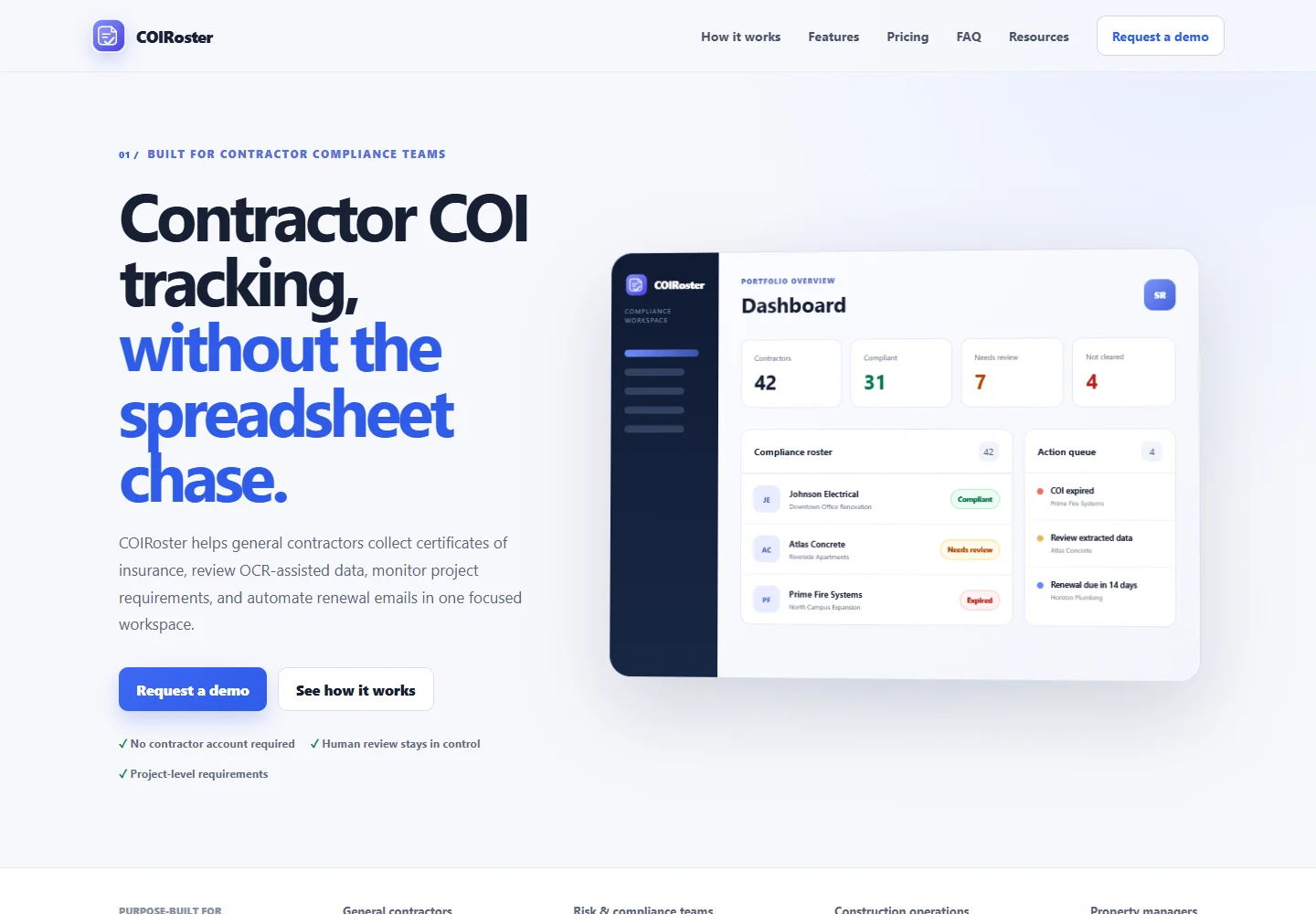
COIRoster: track certificates with explicit rules.Public product website · capture and illustrative data
Your situation
You manage subcontractors and certificates of insurance: which documents are missing, which requirements need review and whom should you chase?
The choice to examine
The workflow connects project requirements, account-free uploads, checks and reminders configured at 90, 60, 30 and 7 days.
Examine the separation between flagging a gap and approving a record.
What still needs checking
Coverage decisions remain human.
The presented context is certificates of insurance.
Réponda: from a call to handover to your team.Illustrated product workflow
Your situation
A call arrives while you work.
You want to capture the need and give it a next step without reconstructing the conversation later.
The choice to examine
Follow reception, qualification, the connected-calendar action and the email summary.
The design choice to examine is the boundary between an authorised action and human handover.
What still needs checking
Services, information and calendar rules are defined before activation.
Out-of-scope requests need to reach your team.
Invoice: prepare a record, then have it reviewed.Published V1 scope and document workflow
Your situation
Receipts arrive as photos or PDFs.
The work goes beyond reading text: fields need finding, gaps need flagging and an export needs preparing.
The choice to examine
The workflow separates collection, extraction, classification, configured checks and accounting approval.
Examine user roles and correction before Excel or CSV export.
What still needs checking
Accounting keeps approval.
Direct accounting connections and other announced extensions are planned for V2, with no published release date.
CRM: why this enquiry deserves your attention.Illustrative example · fictional data
Your situation
Several enquiries arrive together: which should you revisit first, and what information is missing before you call?
The choice to examine
Examine the sample enquiry, business criteria and priority for review.
The key choice is to explain the priority through your criteria rather than present a score as an automatic decision.
What still needs checking
You confirm the context, team capacity and next commercial action.
Inventory: turn photos into a record for review.Illustrative example · fictional data
Your situation
You photograph assets or premises at check-in or check-out and then need the information in a usable record.
The choice to examine
The example separates input photos, agreed fields, prepared information and review.
Garages are one use case; the scope also covers inventories and condition reports.
What still needs checking
Unreadable details need a new capture or correction.
A photo does not replace professional inspection.
RAG: find an answer and check its source.Illustrative example · fictional data
Your situation
Your team knows the answer exists in the documents.
It needs the right information without reopening the same folders for every request.
The choice to examine
The example connects a question, an authorised source and an answer for review.
The key choice is to keep source checking possible and recognise missing information.
What still needs checking
Access rules and source review remain essential.
A fluent answer is not enough to establish accuracy.
Scoring: prepare a priority, then decide.Illustrative example · fictional data
Your situation
Your history may contain useful signals.
You want to surface situations for review early enough to act.
The choice to examine
Examine the input, proposed output and your team’s check.
Clarify the decision the signal supports and the cost of a false alert or missed case.
What still needs checking
The example is not a measured performance result.
Held-out test data and a baseline comparison are needed to evaluate your context.
Compare your ideas with your team.
Use the PDF to describe your need and the CSV matrix to compare priorities.
The architecture example then helps explain how data, tools and approvals can connect.
A real challenge?
Let’s start there.
Describe your situation.
We can identify a practical next step.